Showing posts with label Engineering. Show all posts

Friday, May 3, 2013

Morality of Solution Manuals For College Homework

I recently got into a discussion with a former professor about the morality of providing college students with a solution manual to problems in a textbook. I’ve taken several of my emails and re-written them here, polished up a tad bit.

--------------------

Background Knowledge: Many college courses use textbooks to help provide reading material, as well as assign homework from. Many of these textbooks have a companion solution manual, published by the same publisher. Most professors attempt to tightly control access to these solution manuals.

The Question: Is providing students with a solution manual morally wrong?

  • I submit that the point of taking a college class is to learn useful knowledge and skills.

  • I submit that students are taking the class of their own free will, and in fact paying to take it.

  • I submit that if a student fails to learn material, the only being harmed is that student. (No one else!)

  • If a student was taking classes just for themselves, there would be no need for anything other than learning. No need to exams; No need to prove knowledge to anyone. However, this is rarely the case. Most commonly, students take college courses in order to get a degree (and therefore a more profitable job). Since Purdue (or whatever university is in question) grants this degree on the assumption that students are really learning the knowledge that is taught, Purdue is putting their name on the line to say that X student does know X knowledge. Therefore I'll concede that X knowledge needs to be tested in some way. Hence we have exams.

  • I therefore submit that the purpose of exams is to test knowledge, while the purpose of homework is only to help students learn.

  • This affects our current topic (a solution manual to homework problems in the textbook). If the sole purpose of homework is to help students learn, then testing and proving knowledge should be no part of it (That should only come into play during exams). It doesn't matter if a student knows the material during or after homework. From this it follows that homework should not only not be graded, it should be optional. In a perfect world, homework would be optional completely, and if turned in would be checked to provide feedback to students; it would not be graded though. This would allow students the opportunity to learn, without punishing them for not learning fast enough.

    We don't live in a perfect world though, and there is also the consideration of how to we keep students involved. Many professors feel the need to force students to be involved. Hence homework is graded (and attendance is recorded). While I disagree with both of those, it's just the world we live in. We can mitigate them though, by making homework (and attendance) worth very little. And by dropping stupid homework policies like keeping track of how students complete homework. This brings us to the solution manual.

    With students that use a solution manual, there are three possible situations (One might argue that 2 and 3are the same, but I'll address each separately for the sake of logical completeness).

    1. Students attempt homework problems before looking at the solution manual, using it to check answers and help with areas they still don't understand
    2. Students copy word for word from the manual without first attempting the assignment, but still pick up a lot of the knowledge just through memorization and repetition.
    3. Students copy word for word from the manual without first attempting the assignment, and learn nothing.

    Lets examining all three of these possible scenarios.

    In scenario 1, students are learning the material without copying. I've found that most professors don't object to this, but also don't believe that it ever happens (assuming instead that students will always take the easy way, and that any other assumption is just nativity). Regardless of the frequency though, if no one objects, then it's not a problem.

    In scenario 2, students are copying, but still learning. I've found that this scenario too is assumed to be highly unlikely by most people. And unlike scenarios 1, I'll concede that it probably is. However, again regardless of the frequency, if the student is still learning, then it's not a problem.

    Finally, we have scenario 3 (The only area where there seems to be actual disagreement). These are the students who will look at the solution manual, copy word for word, and not learn anything. These students are the reason that professors for the most part try their hardest to remove solution manuals from general availability. But here is the thing. There's nothing wrong with students doing this, and here's why.

    If you look at my assertions 3 and 4 together, I submit that students who are learning for themselves are responsible only to themselves. Responsibility to Purdue only comes into play when Purdue is putting it's name on the line to vouch for a student. Since exams cover the testing and validation of knowledge, Purdue is covered. Therefore until a student takes an exam (during homework, for example), they are responsible solely to themselves, not to Purdue (and not to professors). If a student doesn't want to learn, then a student doesn't have to learn. It follows that if a student doesn't want to complete homework assignments or do complete them in a way that doesn't help learning, then they don't have to, and professors shouldn't be attempting to force them. It is the professors' job to teach students who are willing to learn, not to control students who are unwilling to learn.

    This covers all three possible situations that arise from students having a solution manual. If none of them are objectionable, then having a solution manual isn't objectionable. Additionally, another reason that banning solution manuals is silly is that going to office hours has the exact same result. Solutions are provided. And nearly every college course has office hours.

    Friday, February 15, 2013

    Engineering - 6 Weeks In

    I've now had a real engineering job for 6 weeks, and I think I'm starting to settle in. The first few weeks were mostly setting up the field office, buying desks and chairs, getting the tech up and running, setting up the paper trail, etc. The last month though, I've really started to get into things. My job consists primarily to two areas: Technical drawings, and being a conduit for questions (from sub-contractors to the official design engineers. In the past month, I've learned some things.

    1.) Affter 4 years to get an engineering degree from Purdue, I know basically nothing about what is done here in the real world. I'd be frustrated except that I've realized that really...

    2.) ...Entry level engineers are basically sponges. Or at least, good entry level engineers are. Sponges in that most of the job really is just soaking up knowledge and trying to learn as quickly as possible.

    3.) The "Final Version" of a project schedules isn't complete until the project is. (Additionally, MS Project sucks.)

    4.) In-company politics do happen, even especially at a small company. (One reason that I'm so low in the hierarchy at this point; I'm almost still an outsider, so I watch rather than participate).

    5.) Fairness is a great thing in a boss. Everyone screws up, and I'm certainly no exception. Getting my ass chewed out after I do doesn't really bother me. But getting yelled at for doing what I was instructed to do (or not doing something that I was told not to bother with) gets old real fast. Having a boss that yells only when it's deserved is a treasure.

    6.) Never buy a car from Hubler Chevrolet in Rushville. They'll pressure you, they'll lie to you, and they'll try to slip in $2400 in extra cost, hoping you won't read the contract. (Not directly related to the job, but I only bought a car because I have money from the job).

    7.) Windows XP sucks.

    8.) Computers that run Windows XP and are a decade old suck.

    9.) 2013 HP Probooks running Windows 7 are wonderful.

    10.) ALWAYS keep phones numbers and business cards.

    11.) In the field, lamination is almost a necessity.

    Thursday, March 22, 2012

    What An Engineering Degree Gets You

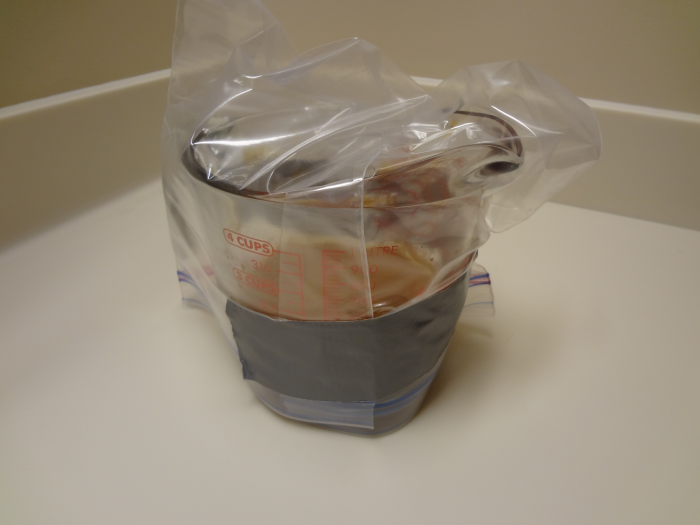
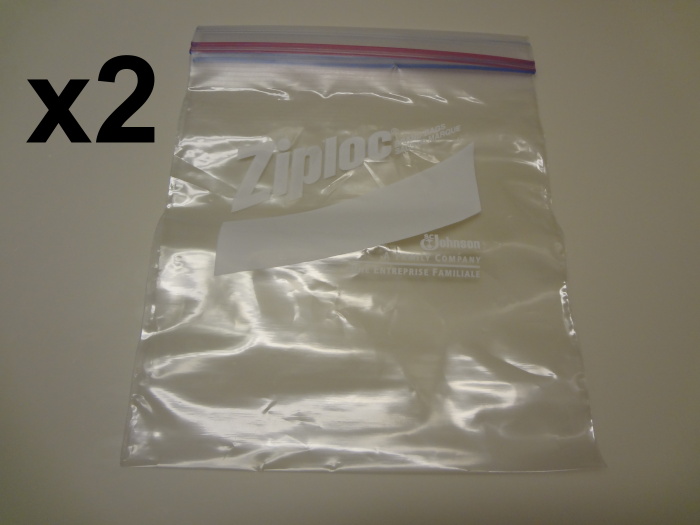
    Do you ever find yourself full after only eating half your meal, and want to be healthy and save the rest for later, but don't have clingy wrap? Well, the clever geniuses here in my head have found a solution! You will need:

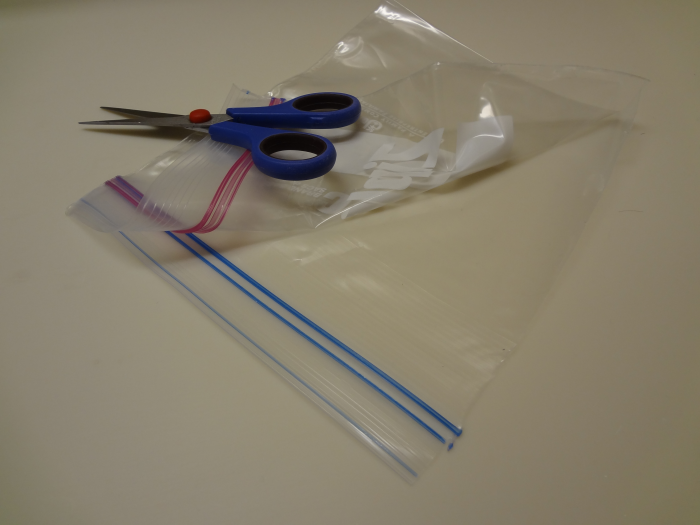
    Ziplock Baggy (x2):


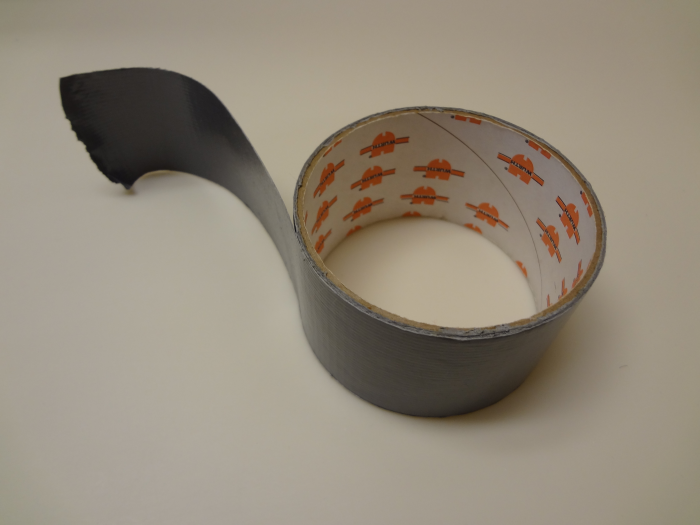
    Duct tape:


    Scissors:


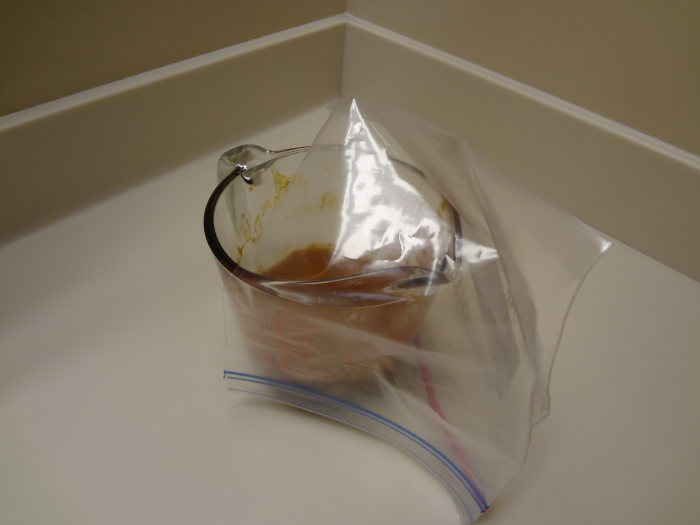
    Food to save:


    Step 1:
    - Cut the bags down one side.


    Step 2:
    - Place one bag over one side of container.


    Step 3:
    - Place second bag over the other side.


    Step 4:
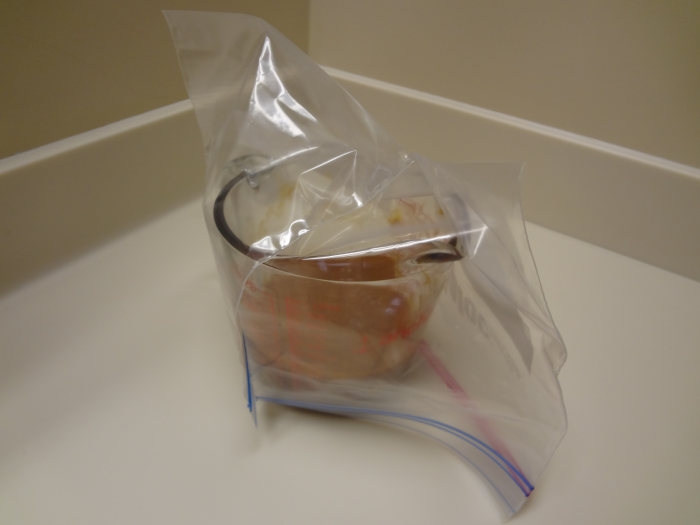
    - Wrap duct tape around to hold bags together


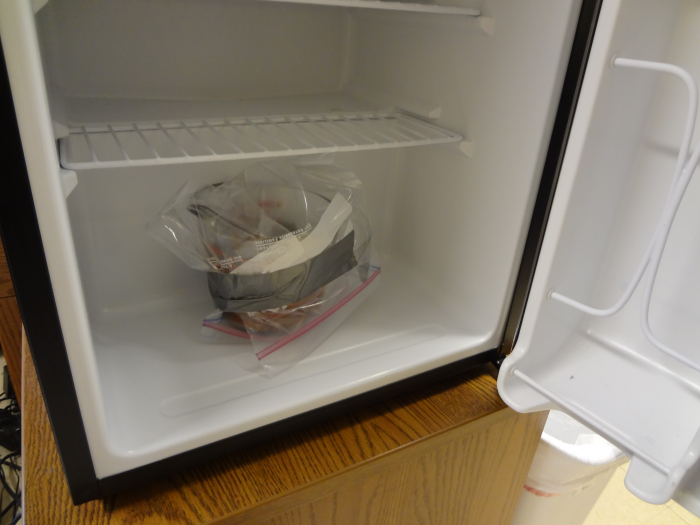
    Step 5:
    - Place covered container in refrigerator.


    Now you can be healthy and eat less, and be more cost effective by making a can of chili last two meals. Success!
     

    Friday, October 14, 2011

    Well Shit ....

    I got my grade back today for my 3rd exam. Soil mechanics, or in more colorful terms, geotechnical engineering. I got a 68%, which is a D. A high D, but a D nonetheless. The problem with this exam is that I didn't blow off studying. I studied for quite a while, I made up a cheat sheet. And even more frustrating, is that I knew how to do everything. 4 sections, 3 main problems and 1 misc section. I knew all 3 of the big parts, but knew I'd miss a few on the misc true/false questions, and I did.

    The big point loss came though, from running out of time. 10 minutes more and that grade would have been an 88 easily, but I ran out of time and didn't finish the last problem. I also realized with 30 seconds left that I made a mistake in the beginning of said last problem. I went back and fixed it, and wrote out what I should have done. I didn't have time to redo all the calculations though, and I wrote that. I got zero partial credit. I find that harsh, but not unfair.

    This is really sort of a blow to me, because the past few weeks have been really difficult. I went home for fall break to recharge and came back in a good mood, ready to take on the rest of the semester. And then this happens. And it happens on an exam where there was really nothing I could have done better in preparation. It's the kind of thing that makes me question whether I have what it takes to be an engineer, because this isn't supposed to be on of the hardre classes.

    I walked out of class after looking at the graded exam, which was passed back at the beginning. I walked around for a while outside, and then came here. Frankly I want to curl up into a ball and sleep, because sleeping I get to start over with a new life, however temporary the dreams are. But I can't.

    So I came to a computer lab, pulled out some engineering paper, and started working ahead on thermo homework. I've got a thermo exam next week, which is going to be rough. I got a 97% on the last one though, my only decent test score this semester. My plan then, is to focus my efforts for the rest of today on thermo. I'm going to study this entire weekend for this exam, and hopefully blow it's head off, because I need to reassure myself that I can.

    And if I do fail this next exam, even after these weekend of extra studying and in a class I'm good at ... then I'll reassess whether this is the career choice I really want to be in, and if a change might be necessary.
     

    Friday, September 9, 2011

    Interesting Homework

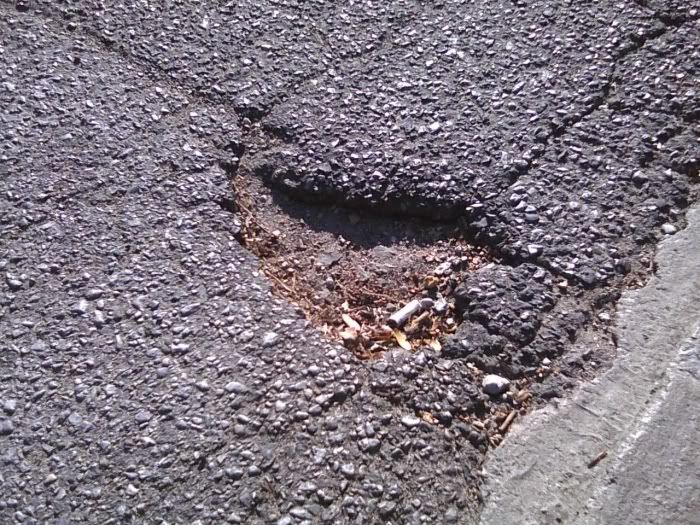
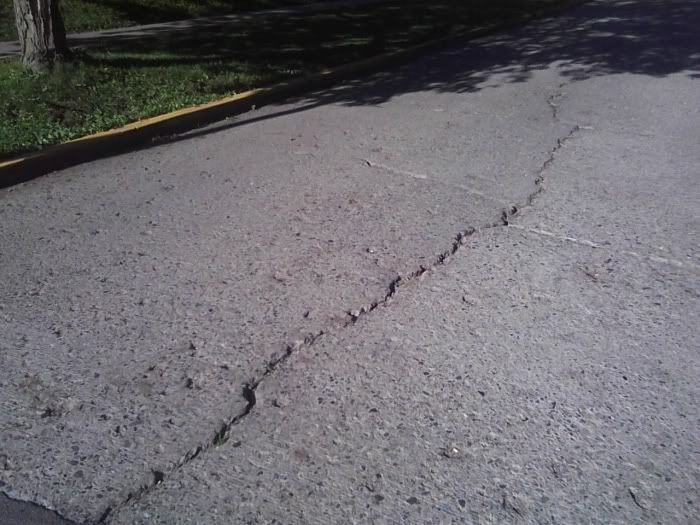
    For the first time in quite a while, I had a homework assignment that was actually kinda cool. I had to go out and find two pavement problems around campus. Take a picture of each, and classify it. Since I bike around campus regularly, I didn't have to go find any, I just stopped by two places on one of my regular rides.I think the pictures are pretty interesting, so I'm posting them here.

    The first is quite obviously a pothole. As cars drive over weak spots in wet pavement, the compression from the weight of the car forces water out, and the water pulls out some asphalt/concrete particles as well. Over time, a hole builds up under the surface where those particles used to be, and eventually it collapses down, forming the pothole.


    The second is a longitudinal crack, which is a crack going along the lengthwise direction of the road, not crossing it. This one is actually pretty terrible, it's as wide as an inch in some places. If you also notice, the pavement isn't smooth at all, you can see lots of tiny holes and gaps. It's a pavement that is old and needs to be repaired or replaced, soon.


    Thursday, March 31, 2011

    Ye Old Pump Co

    This is a poster I created for an imaginary pump maker, with a humorous twist.


    Wednesday, March 30, 2011

    14 Reasons To Date an Engineer

    14. We are trained to do it right the first time

    13. We are used to all nighters

    12. We are always willing to experiment

    11. We know how to decrease and increase friction

    10. We know all about heat transfer

    09. We do it with more torque

    08. We can wire your circuits

    07. Free body diagrams

    6. Potential for smart children

    5. Engineering couples have better moments

    04. We know how to deal with stress and strain

    03. We know it's not the length of the vector that counts, but how you apply the force

    02. "Lubrication, Friction and Wear" is actually a class

    01. The world DOES revolve around us....we pick the coordinate system.
     

    Thursday, November 11, 2010